

Docking techniques for boaters, an overview of the most common docking methods
Learn about the most common boat docking techniques, from Mediterranean stern-to mooring to alongside berthing.
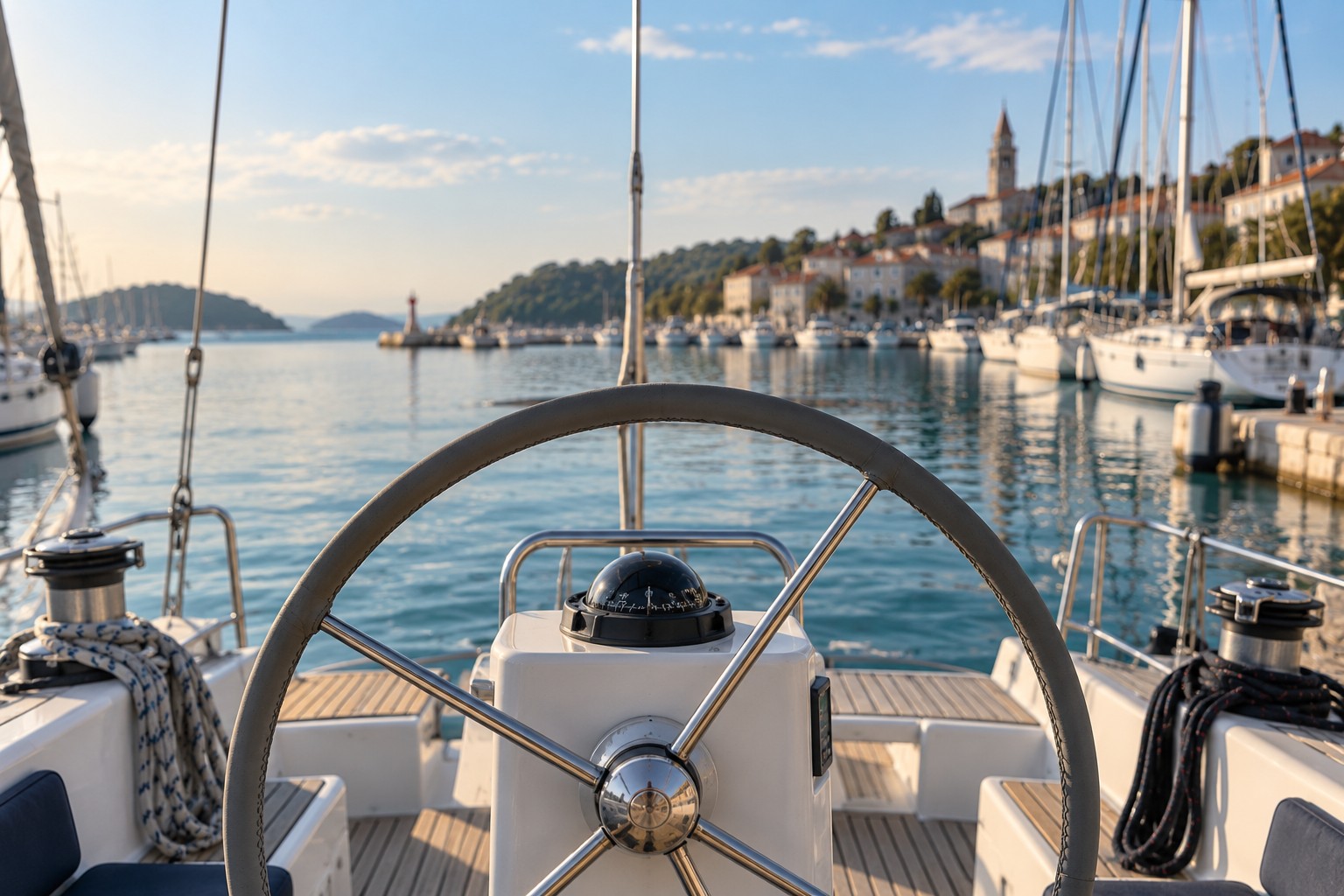
Docking in practice
The right docking technique always depends on the situation
One of the most exciting parts of boating is arriving at a new marina and manoeuvring the boat precisely into its berth.
For many beginner boaters, docking is one of the biggest challenges, as you need to pay attention to the boat’s movement, the surroundings, the wind and the correct technique all at the same time.
However, there is no single universal docking method. The type of marina, the size of the boat, weather conditions and the specific situation all determine which solution is the most suitable.
Let’s take a look at the most commonly used docking methods.
Mediterranean mooring (stern-to mooring)
Mediterranean mooring is one of the best-known docking methods, especially in the Adriatic region.
With this method, the boat approaches the quay stern-first, while the bow is usually held in position by an anchor or a pre-laid mooring line, known as a lazy line.
This method is very common in Croatian marinas, where boats are positioned side by side, perpendicular to the shore.
When mooring stern-to, it is particularly important to choose the right speed, understand how the boat moves and take environmental conditions into account. When using an anchor, the amount of chain paid out also matters: as a general rule, it is usually around 4–5 times the water depth to ensure that the anchor holds securely.
With proper practice, this manoeuvre can be performed much more confidently than it may seem at first.
Alongside mooring (parallel docking)
When mooring alongside, the side of the boat approaches the quay parallel to it.
This may appear to be one of the simplest docking methods, but precise boat handling and the correct approach angle are still essential, especially in wind or current.
For secure mooring, four lines are generally required: a bow line, a stern line and two spring lines, which prevent the boat from moving forwards or backwards in relation to the quay.
This method is often used when refuelling, during short stops or in places where there is enough space to position the boat alongside the quay.
The key to successful alongside mooring is slow, controlled movement and an accurate feel for how the boat responds.
Bow-to mooring
In certain marinas, the boat approaches the shore or designated berth bow-first.
This method is less common than stern-to mooring and is mainly used in places where it is more practical to keep the stern of the boat, including the engine area or bathing platform, open towards the water.
Proper use of the mooring lines is also important in this case. While the bow is secured to the quay, the stern is held in position by an anchor or lazy line, ensuring that the boat remains stable while allowing for possible movement.
Box berth
The term box berth does not actually refer to a specific manoeuvre, but rather to the layout of the berth itself: the boat enters a designated space between two pontoons or piles.
This is one of the most common arrangements in modern marinas, where each boat has its own designated berth. The boat usually enters stern-first or bow-first, depending on the layout of the marina.
For beginners, this can often be one of the biggest challenges, as the limited space requires precise control and good situational awareness.
Successful docking in a box berth requires the right speed, a good understanding of the boat’s dimensions and continuous small corrections.
Anchoring
When anchoring, the boat is held in position not by a fixed quay but by a properly set anchor.
This is a common solution in bays, when stopping for a swim or in places where there are no developed marina facilities.
For safe anchoring, it is important to consider the water depth and the type of seabed. Sandy or muddy bottoms generally provide better holding than rocky seabeds. It is also important to check that the anchor has set properly, for example by gently applying reverse power to put tension on it.
Which docking technique should you use and when?
An experienced boater does not rely on just one docking method but adapts to the situation.
A different solution may be ideal in a crowded Mediterranean marina, a narrow box berth or a calm bay.
Knowing and practising different techniques helps make docking a natural part of boating rather than a stressful situation.
Get on the Water with Us!
At Sidro Nautika, we teach you safe boating so that you know what to do in every situation. Although stories of ghost ships are exciting, the best experience is when you return to the harbor as a confident captain. Whether it is a boating course, sailing training, or a motorboat course, with us you can build on solid foundations.
If sea adventures attract you, you can apply for the Skipper C course, which we hold directly in Rijeka and Split, in a real maritime environment. This is the training that allows you to legally navigate on any ocean and sea in the world.
Our offer also includes Yachtmaster A and Yachtmaster B, full maritime navigation training, as well as the opportunity to complete practical-focused sailing maneuvering training and obtain a motorboat license. In addition, our boating license prices and motorboat training prices are transparent, so you know exactly what to expect.
If you already have a boating license and are looking for a boat for your next holiday, check out our sea boat rental options and choose from several thousand available boats!